SPACELAB ILLINOIS
SpaceLab Illinois was an incredible opportunity—one that I was thrilled to be selected for. The program was very extensive, running from March through August and cutting into my school year. Despite the challenge of balancing coursework with the demands of this internship, I knew this was an experience I couldn’t pass up. It was a chance to immerse myself in aerospace technology, work alongside brilliant minds, and contribute to something very meaningful to many.
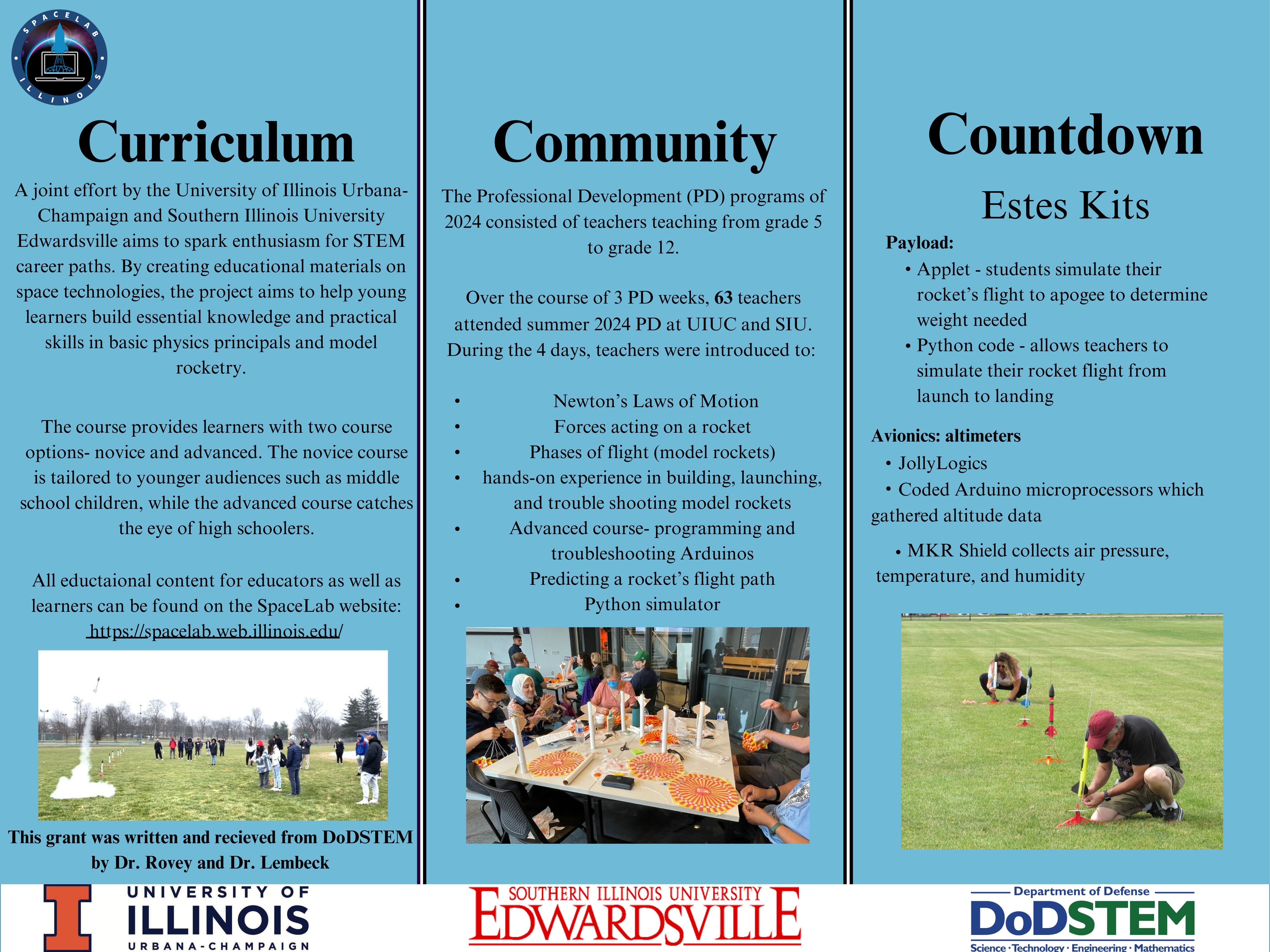
Last summer, I had the incredible opportunity to work as an intern for SpaceLab Illinois at the University of Illinois, funded by the National Defense Education Program (NDEP) for Science, Technology, Engineering, and Mathematics (STEM). A period that truly affirmed my passion for aerospace, I immersed myself in a role that allowed me to do what I love most: sharing my knowledge of aerospace technology and working hands-on with educators from across the U.S. Under the leadership of Dr. Joshua Rovey and Dr. Michael Lembeck, one of my major contributions was developing and delivering aerospace technology lectures. These lectures covered everything from model rocket launches to data interpretation, providing comprehensive training that empowered educators to bring rocket science into their classrooms. I also led workshops on aerospace technology, with a focus on integrating technology into classrooms. I developed a C++ program that allowed the Arduino to function as an altimeter, recording crucial measurements such as pressure, velocity, and altitude onto an SD card. The SD card data was then used to generate graphs for these measurements, which educators could use in classroom settings to teach students about the real-world applications of these concepts. This provided a tangible and engaging way to visualize and understand the physics behind rocketry. What made this experience even more meaningful was the opportunity to work closely with passionate high school and college professors. Their eagerness to learn about coding, physics, and the mathematical intricacies of rocketry was extraordinarily inspiring, and I formed deep, meaningful connections with many educators. I would tailor an immersive, hands-on experience for participants-walking them through the process of assembling a model rocket kit powered by C5-3 grade motors, which necessitated careful attention to safety protocols. For those seeking to push the limits of design and functionality, I introduced the option to 3D-print custom components, including a engineered nose cone with enhanced durability and even more aerodynamic fins. These parts, which I designed to optimize the rocket's stability and durability, allowed educators with access to 3D printers to create unique modifications that would enhance performance and add a personal touch. Being able to teach and share my knowledge with such an engaged and motivated group was deeply rewarding. It reminded me of the dedication my own teachers have shown me, and how their efforts shaped who I am today. Teaching my favorite subjects to an eager audience only strengthened my passion for aerospace and reinforced the value of education.